-2.png)
-1.png)
Turn every incident into insight, action and improvement.
Capture incidents, hazards and non-conformances, manage CAPA through to closure, and turn every issue into intelligence that helps prevent repeat failures.
The gap isn't reporting. It's everything after.
Most teams can log what went wrong. What's harder to see is everything after: who owns the fix, whether it actually closed, and whether the same issue is quietly repeating across sites. When incidents live in paper forms, spreadsheets and shared inboxes, the report exists but the follow-up disappears. The result is corrective actions that stall, evidence that's scattered when an auditor asks, and recurring risks no one connects until they've happened three times.
One connected system for reporting, action and evidence.
Incident reporting
Capture incidents, accidents, hazards, defects, complaints, near misses, service issues and non-conformances through structured digital forms.
Read more →CAPA workflows
Create corrective and preventive actions with ownership, deadlines, priority, status and evidence requirements.
Escalations and alerts
Notify the right people when serious incidents are reported, actions are overdue or issues need review.
Root cause capture
Record contributing factors, root causes, review notes and follow-up decisions so teams can learn from what happened.
Evidence and audit trails
Attach photos, documents, comments, signatures, timestamps and completion records to strengthen the evidence trail.
Dashboards and reporting
Track open incidents, overdue actions, repeat issues, closure rates and trends across sites, teams and departments.
Unlock the guide.
Most operational guides tell you what a platform can do. This one starts somewhere different. It identifies where the gaps are, what they cost, and what a more connected approach makes possible.
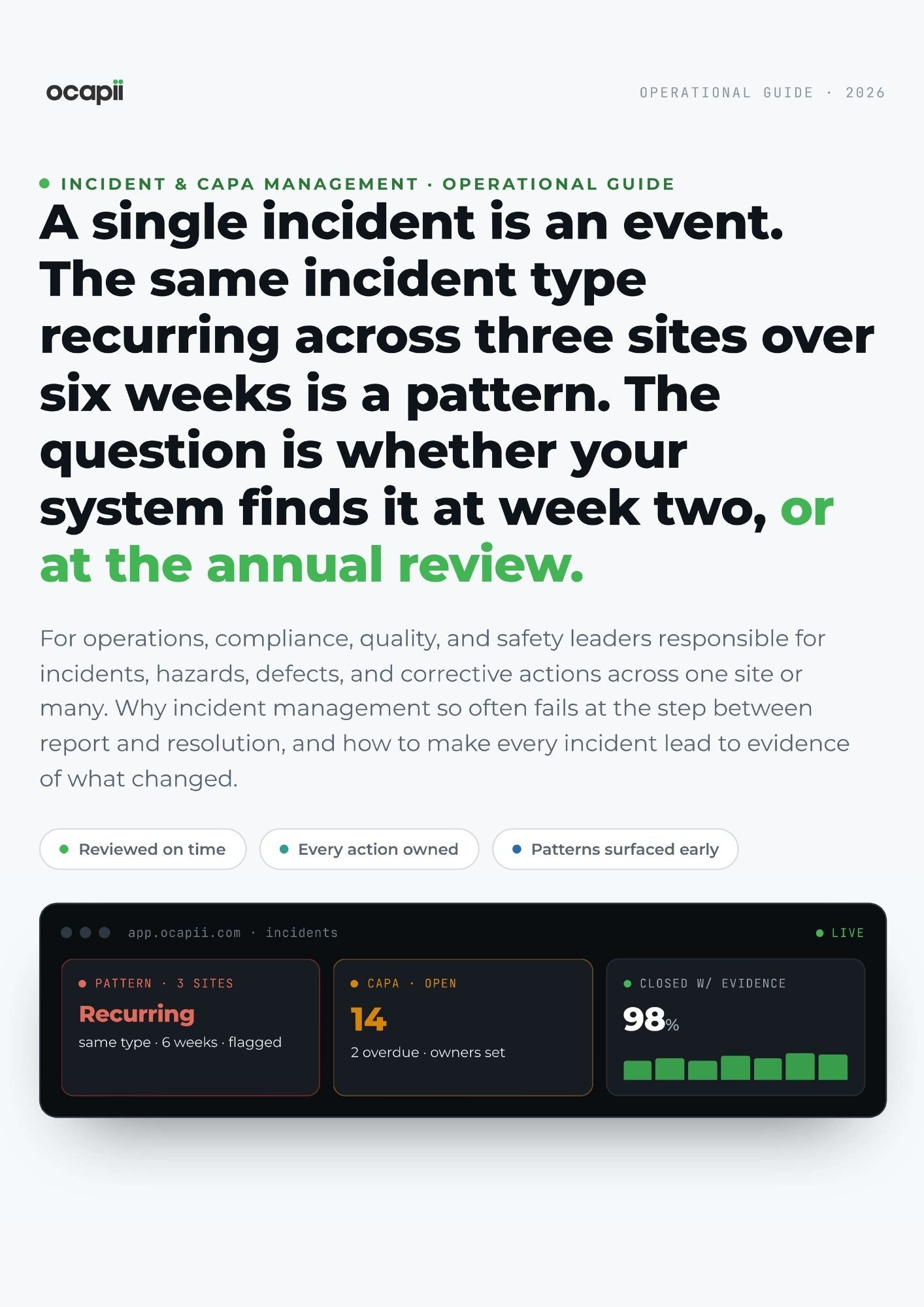 PDF guide
- PDF guide
- 10 min read
- 12 pages
- Operational Guide
A guide which covers a part of your operation that typically runs on a combination of experience, habit, and systems that were not designed to talk to each other.
Get the guide
We never share contact details with third parties. Unsubscribe anytime.
Incident and CAPA management for operationally complex environments.
Incident and CAPA workflows shaped to each sector's risks and follow-up actions.
Create a clearer trail from incident to closure.
Incident evidence is often fragmented across forms, photos, emails, spreadsheets and conversations. Ocapii brings the report, action, owner, deadline, evidence and closure history into one connected record.
Ready to turn incident data into action and insight?
OCAPII turns incidents into assigned actions, closure evidence and operational insight, helping teams resolve issues and reduce repeat failures.
Incident and CAPA management common questions
CAPA means corrective and preventive action. Corrective actions address what has already happened. Preventive actions help reduce the chance of the same issue happening again.
Ocapii can support many incident types, including accidents, hazards, defects, near misses, complaints, non-conformances, failed checks, maintenance issues, quality failures and operational exceptions.
Yes. Incident reports, failed checks, overdue tasks, sensor exceptions or other configured events can be connected to workflows that create actions, alerts or escalations.
Yes. Teams can capture root cause information, contributing factors, review notes and follow-up actions as part of the incident and CAPA workflow.
Yes. Ocapii is designed for single-site and multi-site operations, giving local teams a clear way to report issues and leaders a wider view of trends, open actions and recurring risks.
No. Incident and CAPA workflows can support safety, quality, compliance, facilities, food safety, service, estates, maintenance, manufacturing and operational risk management.