-2.png?width=400&name=Untitled%20design%20(4)-2.png)
-1.png?width=400&name=Untitled%20design%20(1)-1.png)

Ask most care home managers what takes up the most time in their week, and the answer is rarely the work of care itself. It is the work around it.
Meal orders that arrive by phone, WhatsApp or handwritten note and then have to be cross-referenced against a dietary record that lives somewhere else. Visit bookings handled by email, with follow-up tasks that someone has to manually convert into room preparation, staff notification and access arrangements. Food safety records maintained on paper, with corrective actions that sometimes get closed and sometimes do not. Family questions answered by whoever picks up the phone, from memory, without a consistent record of what was said.
None of this is care. But all of it takes time away from it.
The cost of this operational layer is rarely calculated. It tends to be accepted as a feature of running a care home rather than a problem worth solving. But it adds up.
A care home kitchen spending an hour a day managing orders manually, cross-referencing dietary requirements and updating stock by hand is spending roughly 365 hours a year on work that should be automatic. A care team fielding family phone calls that could be answered through a conversational interface is giving up time that could go to residents. A manager chasing corrective action closure across paper food safety records is doing work that a connected digital system would do for them.
The information is already there. The requirements are known. The challenge is connecting them so that care teams are not spending their shift on the operational layer. They are spending it on care.
This is the shift ocapii was built for.
Not by adding technology burden, but by automating the operational work that sits behind care delivery quietly, in the background so that the teams delivering care have more time, fewer errors and a clearer view of what is happening.
In the kitchen, that means meal orders flowing directly to the right preparation stage, with dietary requirements and allergen flags already attached. No manual cross-referencing. No chasing. Rotating menus managed centrally. Stock updating as orders are confirmed. Food safety checks running digitally, with automatic alerts when something needs attention and corrective actions tracked from raise to close.
For visit bookings, it means a confirmed booking automatically triggering the tasks that make a visit possible, room preparation, staff notification, access arrangements without anyone having to translate a calendar entry into a task list. Families can book and ask questions through a conversational interface rather than calling. The booking becomes a workflow. The workflow becomes evidence.
For food safety compliance, it means corrective actions that are raised, assigned and tracked to closure. Missed checks that generate alerts rather than gaps. Audit trails that exist not because someone assembled them, but because they were created automatically as the work was done.
The organisations getting ahead in care are not doing more. They are doing the same things smarter.
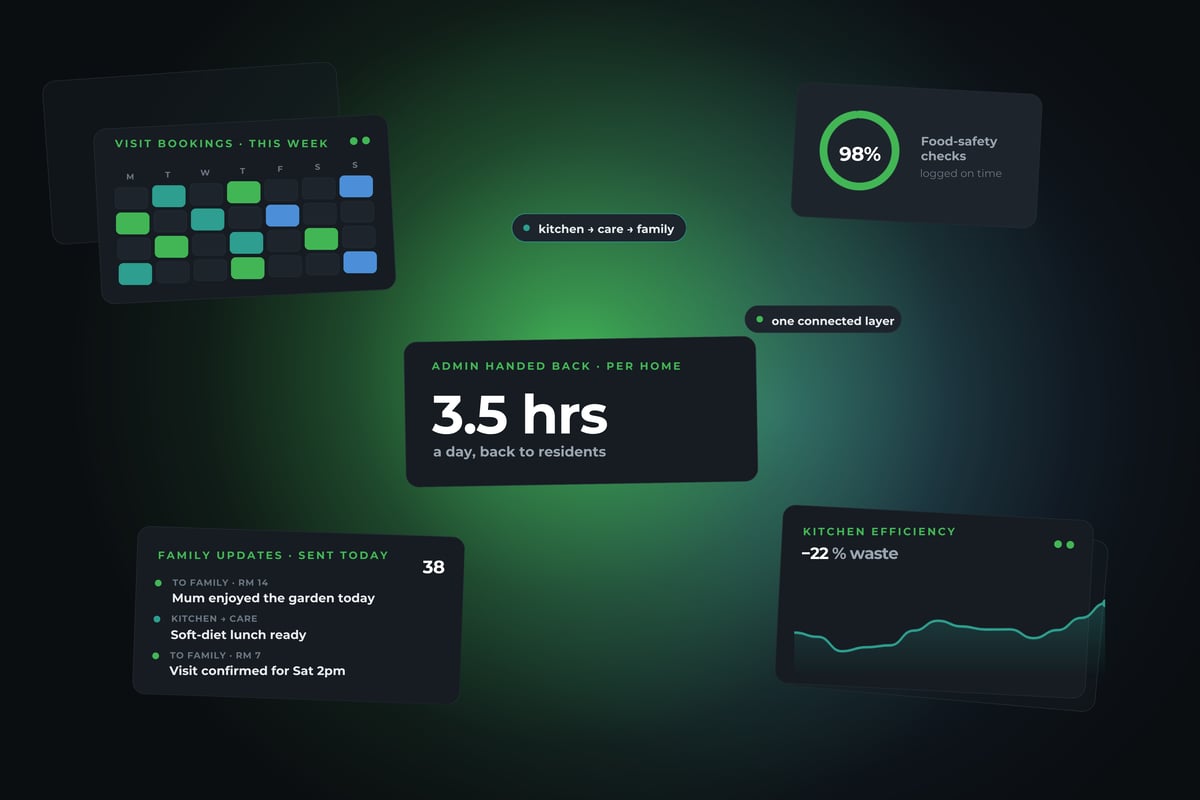
A single care home running on connected operations saves an average of 225 minutes per day across kitchen, compliance and care admin. That is not a marginal gain. Across a group of 15 homes, it represents more than 1,300 hours per year, per site hours that go back to residents, not spreadsheets.
The work behind care will always need to be done. The question is whether it is done manually, in parallel, on paper, across disconnected systems or whether it runs in the background, connected, automatic and evidenced, while the team gets on with what they are actually there to do.
That is what smarter operations looks like.
Ocapii helps nursing homes and care groups connect the operational layer behind care delivery from kitchen ordering and food safety to visit booking and family communication. If you want to see what that looks like in practice, book a 30-minute walkthrough.