-2.png?width=400&name=Untitled%20design%20(4)-2.png)
-1.png?width=400&name=Untitled%20design%20(1)-1.png)

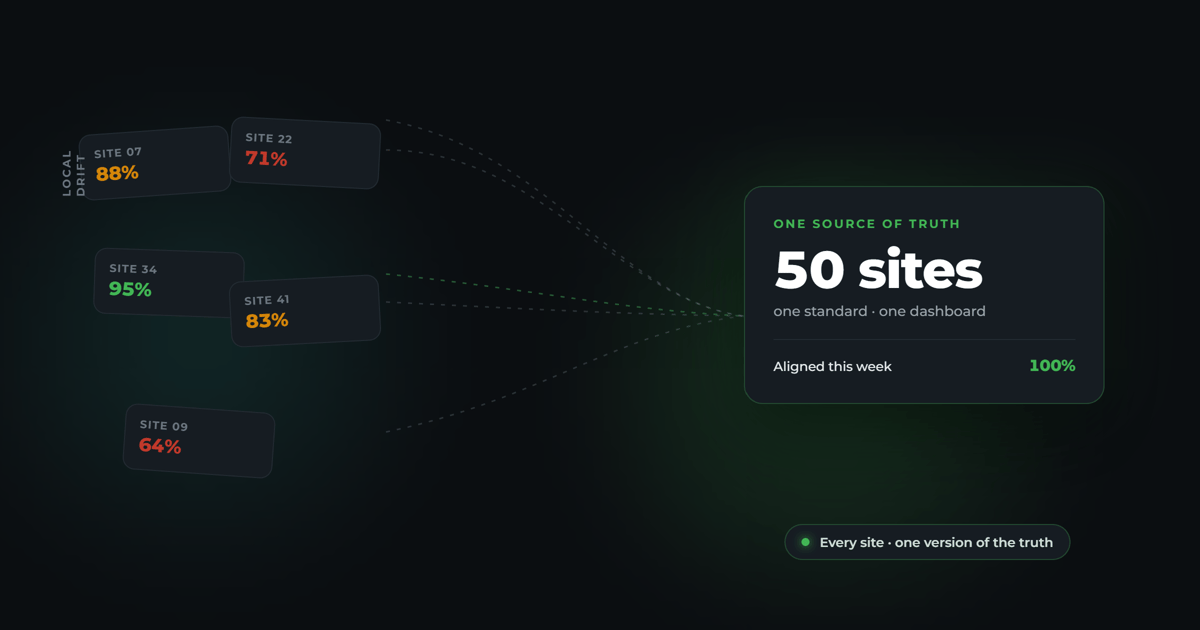
Every multi-site business starts with one version of the truth. One set of checks, one set of policies, one way of working. Then it grows, and the truth starts to fork.
Site twelve is running last year's cleaning schedule. Site twenty-three amended the goods-in form and told nobody. Site thirty-one has a manager who built their own spreadsheet because the official process "didn't fit". None of it is malicious. All of it is invisible from the centre, until an audit, an incident or an insurance claim makes it visible at the worst possible moment.
Governance is a structure, not a memo
The usual response is communication: send the update, run the webinar, hope it lands in all fifty inboxes. But consistency built on memos decays the day it ships. Governance has to live in the structure of the system, or it does not live at all.
ocapii is built around a one-HQ, many-sites model. Users, roles, single sign-on and security policy are managed once at headquarters and inherited by every child site. There is no per-site configuration to drift, because the configuration is not per-site.
Content works the same way. HQ publishes forms, documents, workflows and tasks to selected sites or all of them, with version history, rollback and sync-to-latest. When the process changes, every site changes with it, and you can prove which version any site was running on any date. When a distributed update turns out to be wrong, you roll it back rather than sending a second memo to correct the first.
The version history matters as much as the distribution. When an incident investigation asks what process site nineteen was following on the 14th of March, the answer is in the system: this form, this version, published on this date, completed by these people. Without it, the investigation starts with an argument about what the process even was.
One view across the estate
Central control without central visibility is half a solution. The other half is seeing how the estate is actually performing, in one place, without asking anyone to compile anything.
Cross-site dashboards compare, rank and trend every site: completion rates, exceptions, open corrective actions, audit scores. Leaders see which sites lead and which need support, and, more usefully, they see it early, while the gap is a coaching conversation rather than a crisis.
Visibility at estate level also closes the improvement loop. It is one thing to distribute a new process; it is another to know whether it worked. When every site reports into the same dashboards, the effect of a change shows up in the numbers: completion rates move, exceptions fall, or they do not, and you find out quickly either way. Governance stops being about issuing instructions and starts being about measuring whether they helped.
For franchise groups and operators running mixed brands, the same structure flexes: per-tenant branding through to full white-labelling, with module entitlements set per tenant so each part of the estate gets exactly the platform its contract describes. One governance model, many faces.
Room to practise
Estates also need somewhere safe to train and test. ocapii supports sandbox training sites: clearly marked non-production environments where teams learn on real workflows, then reset to a fresh state in one click, with users and access surviving the reset. Production sites can never be reset, by design. Train-the-trainer sessions stop being a risk to live data.
Built for how estates actually vary
- Eleven languages including right-to-left scripts, with per-user preference, for multinational and mixed-language workforces
- Per-tenant branding through to full white-labelling for groups and partner deployments
- Modules enabled per tenant as entitlements, so the platform fits the contract rather than the other way round
- Per-site access assignment, so people see exactly the sites they should and nothing else
None of this requires a heavier head office. That is the misconception that keeps estates on spreadsheets: the belief that central governance means central bottleneck. Structured properly, it is the opposite. HQ sets the standard once, the platform enforces and evidences it everywhere, and the regional and site teams spend their time running operations rather than proving them.
The goal is not uniformity for its own sake. Sites differ, and should. The goal is that the things which must be consistent, standards, policies, evidence, are consistent by structure, while everything else stays local.
Let your IT team see for themselves
Book an Operational Visibility Assessment to answer any questions they may have.