-2.png?width=400&name=Untitled%20design%20(4)-2.png)
-1.png?width=400&name=Untitled%20design%20(1)-1.png)

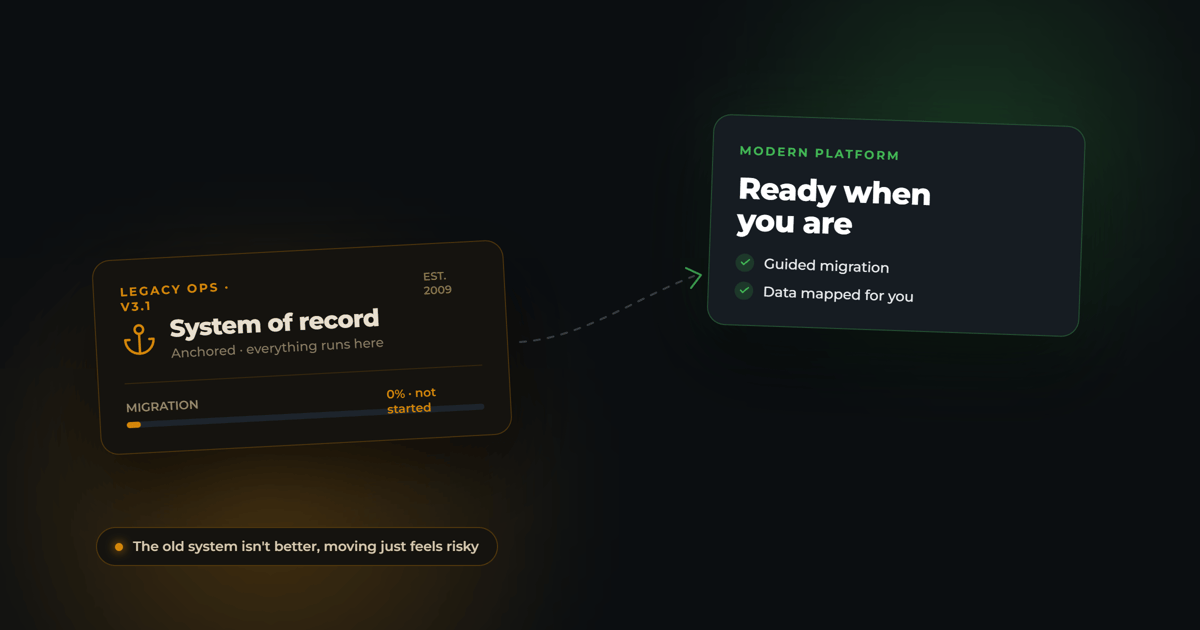
Nobody loves their legacy operations system. The contract renews anyway. Ask why, and the answer is rarely about features or even price. It is about the move.
Years of temperature records, audit submissions, supplier files and user accounts live in the old platform. The teams are trained on it, however grudgingly. The renewal is a known cost; the migration is an unknown risk. So the decision defaults to another year, and the gap between what the business needs and what the system does grows a little wider. The switching cost was never really money. It was fear.
Your history is the hostage
The fear is rational, because operational history is not just data. It is compliance evidence. Those five years of temperature logs may need to be produced for an auditor, an inspector or a court. A migration that loses, garbles or orphans that history is not an inconvenience; it is an exposure. Any vendor asking you to switch owes you a serious answer on this, not a shrug and a CSV template.
Meanwhile, the cost of staying compounds quietly. Paper and legacy processes keep absorbing frontline hours, evidence keeps living in formats an auditor has to excavate, and every workaround becomes another thing the eventual migration has to untangle. Deferral feels safe because its costs are invisible, which is precisely why they deserve suspicion. The renewal is not the risk-free option; it is the option whose risks do not appear on an invoice.
What a structured migration looks like
ocapii's answer is the Data Hub: a migration engine built for moving estates off incumbent platforms, treating the move as an engineering process rather than a spreadsheet exercise.
- Bring data as CSV, XLSX or JSON, with automatic column mapping to ocapii's structures
- Validation before anything is written, so problems surface before they become records
- Row-level error reporting, so a single bad line does not sink a fifty-thousand-row import
- Queued, monitored runs sized for estates, not single sites
- Rollback, so a completed import can be reversed if something is not right
Users, suppliers, historical submissions and temperature history arrive mapped and intact. The evidence trail that protected you on the old system keeps protecting you on the new one.
De-risking the people side
Data is half the move. The other half is people, and the fear that fifty sites will stumble on day one. This is where sandbox training sites earn their keep: clearly marked non-production environments where teams practise on real workflows, make mistakes freely, and reset the site to fresh in one click. Train the trainers, run UAT, rehearse the rollout, all without touching live data.
The technical setup is self-serve too. SSO configuration includes a live connection test that checks discovery, credentials and signing keys with exact pass and fail reporting, so your IT team connects your identity provider without raising a ticket. And rollouts are phased, site by site, because switching an estate is a sequence, not an event.
Phasing also changes the economics of the decision. Instead of one big-bang cutover with estate-wide risk, the first sites go live, prove the model and surface the lessons while the stakes are small. By the time the rollout reaches site forty, it is a routine. The business case stops being a leap of faith and becomes a sequence of small, verifiable steps, each one producing evidence for the next.
A question worth asking either way
Whatever platform you are considering, ask the vendor to walk you through the migration in detail: what moves, how it is validated, what happens when a row fails, and how you would get everything back out again. The quality of that answer tells you how the whole relationship will go. A vendor's migration story is also its exit story, and confident platforms are relaxed about both.
It is also worth asking who does the work. ocapii treats enterprise onboarding as a managed process: migration runs are planned and monitored with you, sandbox environments are stood up for training before anything goes live, and each phase of the rollout is signed off before the next begins. The move is a project with owners and checkpoints, not a login and a link to the help centre.
Let your IT team see for themselves
Book an Operational Visibility Assessment to answer any questions they may have.