-2.png?width=400&name=Untitled%20design%20(4)-2.png)
-1.png?width=400&name=Untitled%20design%20(1)-1.png)

Hear Mira AI in action
Listen to the below blog
A signature at the bottom of a cleaning sheet is a strange kind of evidence. It tells you someone signed. It doesn't tell you what they actually checked, what condition they found it in, or whether the thing that needed attention got dealt with or just got ticked. The standard you're claiming and the record you're holding aren't the same thing. One is a daily reality across every area of the site. The other is a column of initials.
This matters more than it looks. Cleaning and site standards are where reputation lives. A guest forms a view in the first thirty seconds. An inspector forms one too. And when something does go wrong, a complaint, an outbreak, a failed visit, the question is always the same: can you show what was actually done? A sheet of signatures rarely answers it well. It shows intent, not evidence.
The information you'd want is being generated every single day. Every round is a set of observations. Every issue spotted is a decision someone made. It's just that almost none of it gets captured in a way you can see or act on. It evaporates the moment the round ends. The cleaner knew the tap was dripping. The record doesn't.
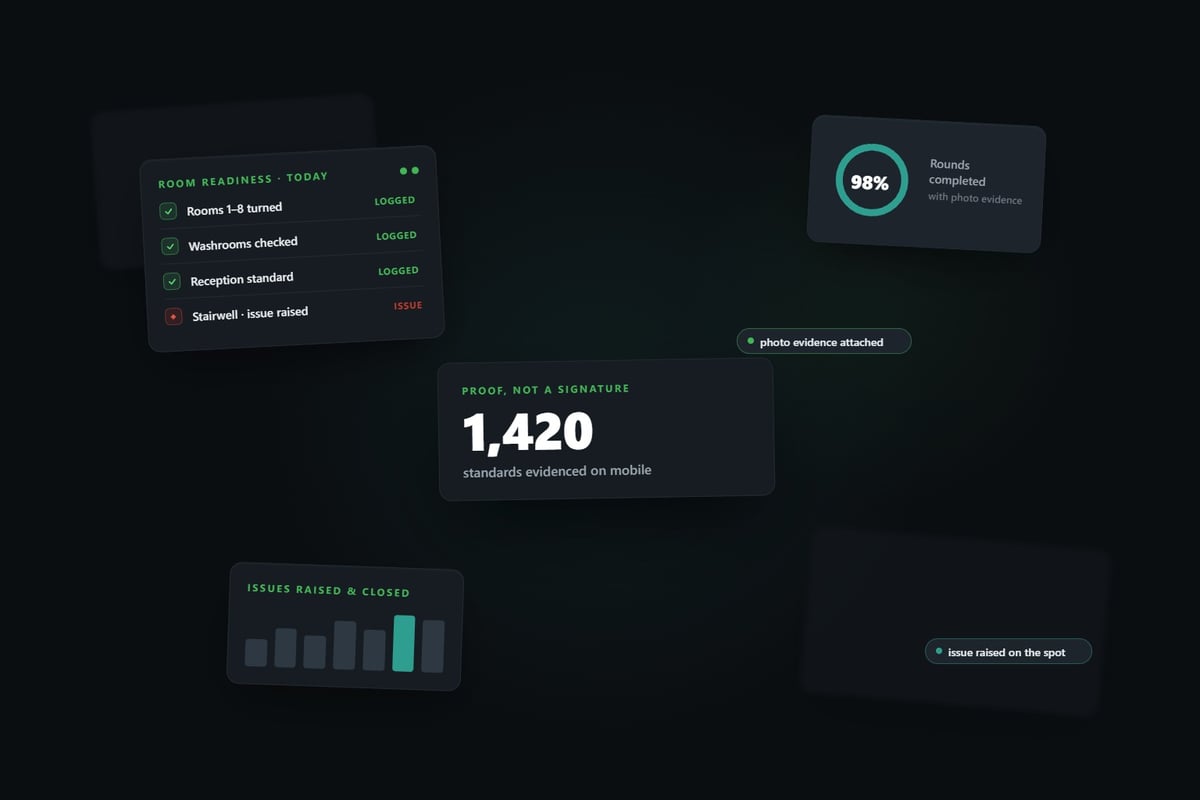
Ocapii captures the round as it happens. Cleaning schedules, room readiness and site standards are completed on mobile with evidence, so the record reflects what was checked, not just that someone signed. An issue found on a round, a fault, a hazard, something below standard, is raised on the spot by photo and becomes a tracked action with an owner, rather than a mental note that fades by lunchtime. Completion is visible across every area and every site, so a manager can see what's ready and what isn't without walking the building.
That's the shift from claiming a standard to proving one. The evidence builds itself as the work is done. When someone asks how you know the site was clean, the answer isn't a folder of signatures. It's a timestamped, photographed record of what was checked, what was found, and what was done about it.
There's a quieter benefit too. When standards are visible, they tend to rise. Not because anyone is being watched, but because the work finally shows. The effort frontline teams put in every day stops disappearing into a filing cabinet and starts being something the whole operation can see and trust.
It also gives a manager their time back. A live view of what's ready and what isn't means the morning no longer starts with walking the building to find out where things stand. The exceptions come to you: the room that isn't turned, the area that failed its check, the issue raised an hour ago that still has no owner. Instead of inspecting everything to find the few things that need attention, you see the few things and act on them. That's the difference between supervising a standard and being able to actually manage it.
A clean site shouldn't be a matter of trust and good intentions. It should be a matter of evidence. The operations that master their standards are the ones that can see them, prove them, and fix what falls short before anyone else notices.
See how cleaning standards can be just one of the components of your ocapii platform