-2.png?width=400&name=Untitled%20design%20(4)-2.png)
-1.png?width=400&name=Untitled%20design%20(1)-1.png)

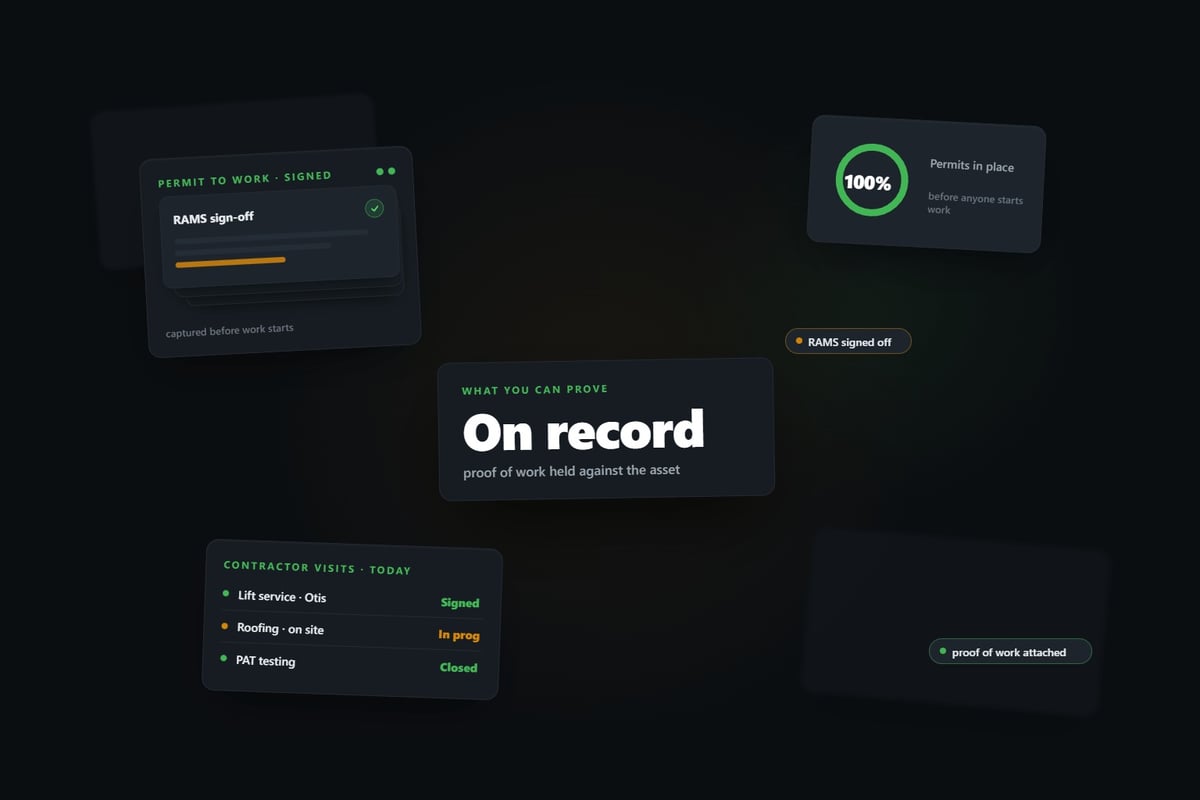
For a lot of operations, the honest answer is "not much". The visit was taken on trust. The paperwork, if it exists, is an email attachment or a signed sheet in a drawer. The proof that the contractor was competent to do the work, that the right controls were in place before they started, and that the job was finished properly before they left, is scattered or simply absent. The work was probably fine. But "probably" is a weak position to be in when something goes wrong, or when an auditor asks you to demonstrate control of the people working on your site.
This is a visibility gap with real exposure attached. When a contractor works on your assets, the responsibility doesn't leave the building with them. If the controls weren't in place, or can't be shown to have been in place, that's your problem to answer for. And the moment to capture that proof is at the time of the work, not three months later when you're trying to reconstruct who did what from a thread of emails.
Ocapii captures the whole visit as a connected record. Permit-to-work and RAMS sign-off are completed before work starts, so the controls are agreed and evidenced up front rather than assumed. Proof of work is captured on site, by photo and record, before the contractor leaves, and held against the asset they worked on. The certificate, the permit, the sign-off and the completed job all sit together, against the right asset, in one view, instead of living in four different places and one person's memory.
The change is from a visit you took on trust to a visit you can prove. Before, the record of a contractor's work was whatever happened to get filed. After, the permit, the controls and the proof of completion are captured as the work happens and attached to the asset, so the answer to "what did they actually do, and was it safe" is already there.
That has a quiet operational payoff beyond the audit. When proof of work is captured before a contractor leaves site, the disputes get shorter, the recalls get rarer, and the asset history tells you what's been touched and by whom. The next decision about that asset is made with a full picture rather than a guess.
It also tightens the handover that usually goes missing. A contractor finishes, and the knowledge of what they did walks out with them, until you need it. Capturing the permit, the controls and the completed work against the asset means the record stays on site even when the people don't. The next engineer, the next manager, the next auditor inherits the full story rather than starting from scratch. Over time, that turns a stack of one-off visits into a continuous account of how an asset has been looked after, which is exactly the kind of intelligence that's usually lost the moment a van pulls away.
Controlling contractors well isn't about more paperwork. It's about capturing the right evidence at the right moment, once, and being able to see it when it counts. The operations that master it are the ones who never have to wonder what a contractor actually did, because the proof is already against the asset.
See how contractor management can be just one of the components of your ocapii platform