


Because the moment that matters isn't in the office. It's on the floor, mid-service, when a customer asks a direct question and a team member needs an accurate answer right now. An allergen matrix in a folder in the back is no help to the person being asked at the counter. A spreadsheet that was right last month is a risk if the recipe changed last week and the spreadsheet didn't. The information is there. It's just not where the question is.
That's the allergen problem in one line. It's rarely a lack of data. It's a gap between where the data sits and where the decision gets made, and that gap is where mistakes happen. A substitution that wasn't signed off. An ingredient swap the front-of-house team never heard about. An answer given in good faith from memory because checking the binder would mean leaving the customer waiting. None of it is carelessness. It's the predictable result of accurate information being kept somewhere the team can't reach in the moment.
Key takeaways
- Allergen mistakes rarely come from a lack of data, but from the gap between where the data sits and where the decision gets made.
- The approved allergen answer needs to be with the team member on the floor, mid-service, not in a binder in the back office.
- Mobile allergen lookup means staff start from the current approved ingredient information, not a best guess from memory, and still check substitutions and preparation risks.
- Building sign-off into substitutions means an ingredient swap and the allergen update happen together as one controlled, recorded step.
- Where customer-facing AI is in use, Mira answers common allergen queries from the same approved ingredient data, must not guess, and directs unresolved or safety-critical questions to trained staff.
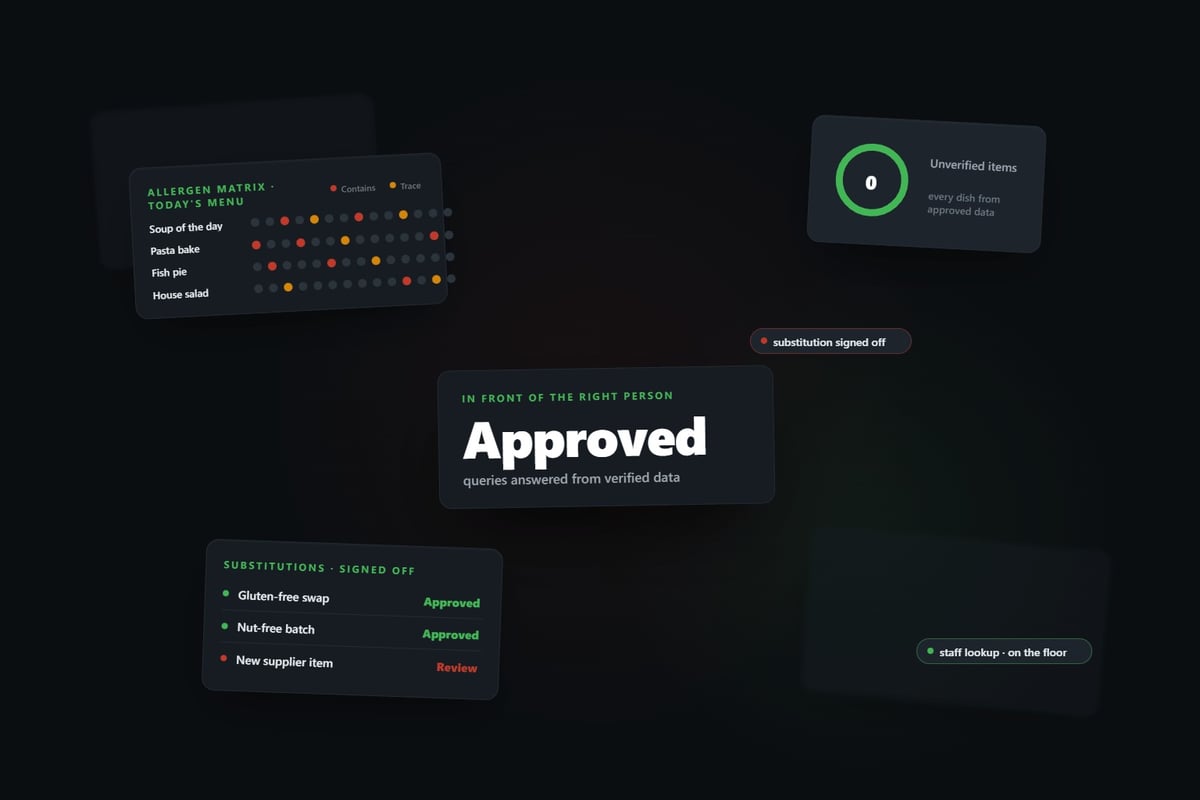
ocapii puts the answer where the question is. Allergen matrices and recipe records live in one place, kept current, with substitution sign-off built in so a change to an ingredient is a controlled, recorded decision rather than a quiet one. Staff can look up allergens on mobile, on the floor, without leaving the customer waiting, so they start from the current approved ingredient information rather than a best guess, check substitutions and preparation risks, and escalate uncertain questions. And where customer-facing AI is in use, Mira answers common allergen queries from the same approved ingredient data, so the source of truth is consistent whoever is asking. Any AI interface must avoid guessing and direct unresolved safety questions to trained staff, and that's how Mira is set up to work: if the approved data doesn't answer the question, or the question is safety-critical, it goes to a trained team member.
The shift is from holding allergen data to having it present. Before, the information was accurate and out of reach. After, it's accurate and in the hand of the person being asked, with any change to it signed off and recorded. The control isn't a binder anyone trusts and no one opens. It's a live, approved starting point the team can stand behind. A recipe matrix tells you what's in a dish; it doesn't prove the kitchen it was made in is free from an allergen. Cross-contact risk, from shared equipment, fryers, surfaces and prep areas, still needs staff judgement on the day.
The substitution point deserves its own line, because it's where good intentions most often come undone. A supplier is out of stock, a product gets swapped, service carries on, and the allergen profile of a dish quietly changes without the matrix, the label or the front-of-house team catching up. It isn't negligence. It's a fast-moving kitchen doing its job faster than a paper record can follow. Building sign-off into the substitution means the swap and the allergen update happen together, as one controlled step, so the information the team relies on doesn't silently fall out of date.
This is one area where the stakes don't need dramatising. The regulatory direction has moved steadily towards clearer allergen information and clearer accountability for it, as the Food Standards Agency's PPDS labelling guidance shows. But the right frame isn't fear of getting it wrong. It's the confidence of knowing that the person on the floor, at the moment of the question, has the same approved information the chef would use, and knows when to check with the kitchen. That confidence is what good allergen control actually feels like.
Allergen safety isn't a document you produce for an inspection. It's an answer your team can give from current, approved information without leaving the customer waiting, with a clear route to a trained colleague when the question needs one. The operations that master it are the ones where the information finally reaches the point of the question.
FAQs
Why do allergen mistakes happen when the allergen information is accurate?
Because accurate information is often kept somewhere the team cannot reach in the moment. A matrix in a back-office folder or an out-of-date spreadsheet leaves staff answering from memory at the counter.
How should ingredient substitutions be handled for allergen safety?
Build sign-off into the substitution so the swap and the allergen update happen together as one controlled, recorded step. That way the allergen information the team relies on does not quietly fall out of date when a supplier is out of stock.
How can front-of-house staff answer allergen questions reliably?
By looking up allergens on mobile, on the floor, from the same current matrices and recipe records the kitchen uses, so they start from the approved information rather than a best guess. Staff should still check substitutions and preparation risks such as cross-contact, and escalate uncertain questions to a trained colleague or the kitchen.
Can AI answer customer allergen questions?
Where customer-facing AI is in use, Mira can answer common allergen queries from the same approved ingredient data, which keeps the source of truth consistent whoever is asking. It must not guess: unresolved or safety-critical questions, including cross-contact concerns, are directed to trained staff. Approved source data doesn't on its own make every AI answer complete, so staff judgement stays part of the process.
See how allergen control can be just one of the components of your ocapii platform