-2.png?width=400&name=Untitled%20design%20(4)-2.png)
-1.png?width=400&name=Untitled%20design%20(1)-1.png)

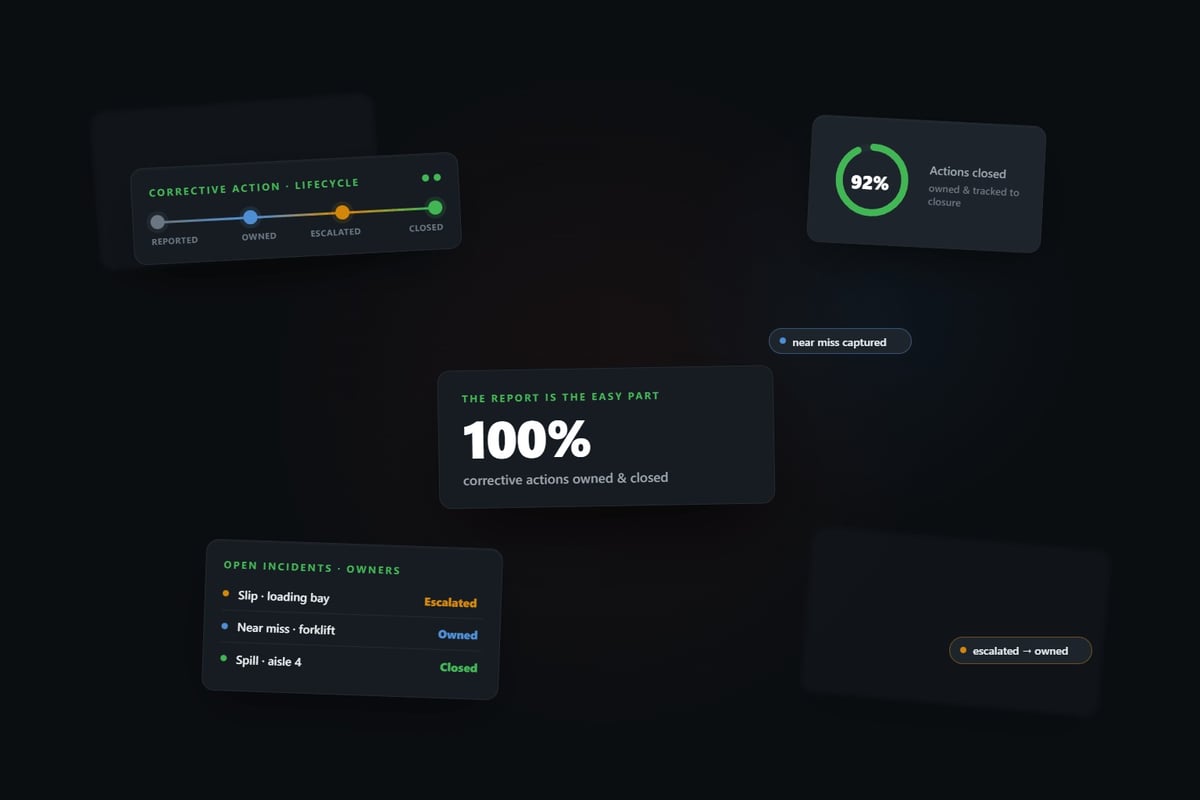
Because the report was never the point. A logged incident that doesn't lead to a closed corrective action is just a record of something that went wrong and stayed that way. The value isn't in capturing that the thing happened. It's in whether the action that followed got owned, tracked, and actually closed, and whether the same thing is less likely to happen again because of it. A filing cabinet full of incident reports with no closed actions behind them isn't a safety record. It's a list of unlearned lessons.
This is where most incident processes quietly leak. The report gets filed and the follow-up drifts. The action lands on someone who's busy, with no deadline anyone's watching, and it slides. Nobody decided to ignore it. It just fell into the same gap everything falls into when there's no visibility: out of sight, out of mind, until the near miss that was reported in March becomes the actual incident in September. The information that could have prevented it was captured. It just never turned into action that closed.
Ocapii is built around the second half of the problem. Incidents, hazards and near misses are captured digitally at the point they happen, with photo evidence, so the record reflects the reality rather than a tidied-up version written hours later. From there, the report doesn't just sit. It escalates to the right person and becomes a corrective action with an owner, a deadline and a required closure, tracked through to done. And because every action is visible, the ones that drift surface before they're forgotten, rather than after they've cost something. Across sites, the trends become visible too, so the same recurring issue stops being treated as a run of unrelated one-offs.
The shift is from reporting incidents to resolving them. Before, the strength of your process was measured by how many reports you collected. After, it's measured by how many actions you closed, how fast, and what you learned. The report becomes the start of something that finishes, not the end of something that gets filed.
There's a cultural effect worth naming. When people can see that reporting something actually leads to it being fixed, they report more, and earlier. The near miss gets raised because raising it visibly works. That's how an operation gets ahead of harm rather than documenting it after the fact, and workplace harm is far too expensive, in every sense, to keep merely documenting.
The trend view is where this stops being about individual incidents and starts being about the operation as a whole. One slip on a wet floor is an incident. The same slip in the same spot across four sites is a pattern, and a pattern is something you can design out rather than just clean up after. When every incident and every corrective action leaves a connected record, those patterns surface on their own, instead of staying hidden as a scatter of unrelated reports in separate folders. The reporting you did to manage today's incident becomes the intelligence that prevents next quarter's.
A mature operation isn't one that reports a lot of incidents. It's one that closes the loop on every one, can prove it did, and gets quietly safer because of it. That's the difference between a record and a result.
See how Incident reporting can be just one of the components of your ocapii platform