-2.png?width=400&name=Untitled%20design%20(4)-2.png)
-1.png?width=400&name=Untitled%20design%20(1)-1.png)
Know where your assets are. Know what needs action.
Track critical assets, monitor movement, capture condition data and connect alerts to operational workflows in one live platform.

Manual asset control breaks down at scale.
Ocapii brings location, status, alerts, tasks, evidence and reporting into daily operations, closing the gap between asset data and action. Teams can see where equipment was last recorded, respond sooner when something moves unexpectedly, assign recovery or inspection tasks, and keep one connected record of movement, response and proof.
Asset visibility that turns into action.
Ocapii brings location, status, alerts, tasks, evidence and reporting into daily operations so the gap between asset data and operational action closes. Teams act sooner and prove what happened.
One connected system for asset location, status and action.
Live asset visibility
Track assets across sites, departments, vehicles, storage areas, field locations or wider operating networks.
Movement history
Build a clearer record of where assets have been, when they moved and when they were last seen.
Geofence alerts
Set virtual boundaries and trigger alerts when assets enter, leave or remain outside expected areas.
Condition monitoring
Capture asset-related data such as impact, movement, temperature, humidity or other configured sensor signals.
Tamper & exception alerts
Surface unexpected movement, device removal, inactivity or unusual asset behaviour where supported by the tracking setup.
Action & reporting
Connect asset events to tasks, corrective actions, inspections, maintenance workflows, dashboards and reports.
Read more →See more. Lose less. Act faster.
Reduce loss
Make it easier to see where critical assets are, when they moved and where they were last recorded.
Save time
Reduce manual searching, phone calls, spreadsheet updates and repeated asset checks.
Improve utilisation
Understand which assets are active, idle, unavailable or sitting in the wrong place.
Strengthen evidence
Create clearer records of location, movement, alerts, actions and ownership history.
Asset tracking for operationally complex environments.
Connected asset visibility shaped to each sector's environments, movement patterns and accountability lines.
Unlock the guide.
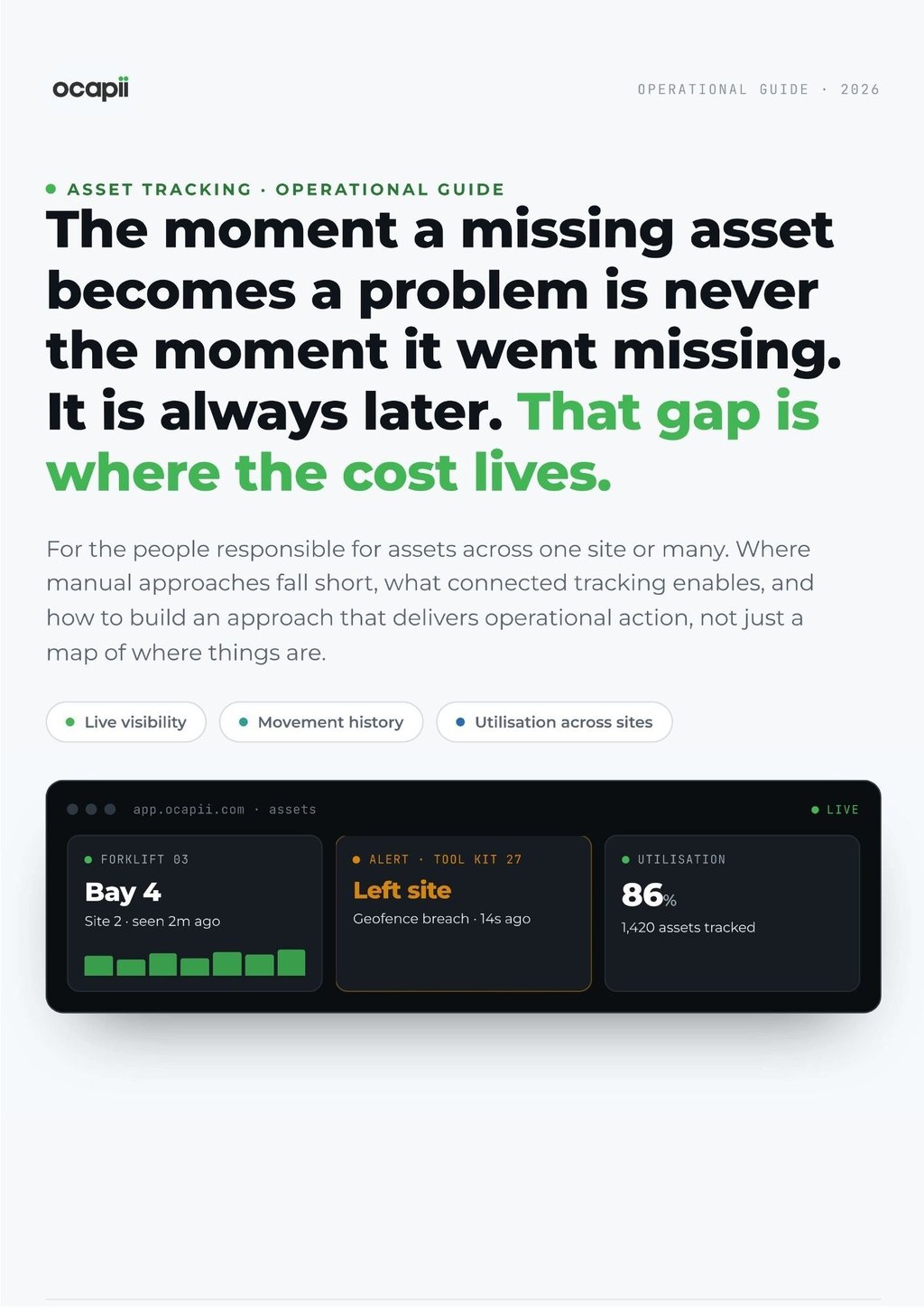
Most operational guides tell you what a platform can do. This one starts somewhere different. It identifies where the gaps are, what they cost, and what a more connected approach makes possible.
 PDF guide
- PDF guide
- 10 min read
- 11 pages
- Operational Guide
A guide which covers a part of your operation that typically runs on a combination of experience, habit, and systems that were not designed to talk to each other.
Get the guide
We never share contact details with third parties. Unsubscribe anytime.
A better way to manage assets across sites and teams.
| Manual asset control | OCAPII-enabled asset tracking | |
|---|---|---|
| Assets listed in spreadsheets | — | ✓ |
| Teams rely on memory or local knowledge | — | ✓ |
| Missing assets are discovered late | — | ✓ |
| Asset checks are handled separately | — | ✓ |
| Recovery actions sit in emails or messages | — | ✓ |
| Leaders see limited utilisation data | — | ✓ |
Ready to make your assets easier to see, manage and prove?
Ocapii helps organisations connect asset tracking with alerts, workflows, inspections, maintenance actions and reporting so asset visibility becomes operational action.
Asset tracking common questions
Ocapii can support tracking for a wide range of operational assets, including equipment, tools, containers, vehicles, trolleys, mobile devices, maintenance assets, medical equipment, catering assets and shared resources.
Different tracking approaches can support different environments, including indoor, outdoor and mixed-location use cases. The right setup depends on the asset type, environment, movement pattern and reporting need.
Yes. Asset events can be used to trigger alerts and workflows, such as unexpected movement, geofence breaches, tamper events, inactivity or condition-related exceptions where supported by the configured device.
No. Ocapii connects asset data with tasks, workflows, inspections, maintenance, evidence and reporting. The aim is not just to see an asset, but to act on what the asset data tells you.
Yes. Ocapii is designed to support single-site and multi-site operations, giving local teams asset visibility while giving leaders a clearer view across the wider organisation.
Yes. Asset records can connect with inspections, maintenance tasks, planned checks, corrective actions and reporting, helping teams manage the full asset lifecycle more clearly.