


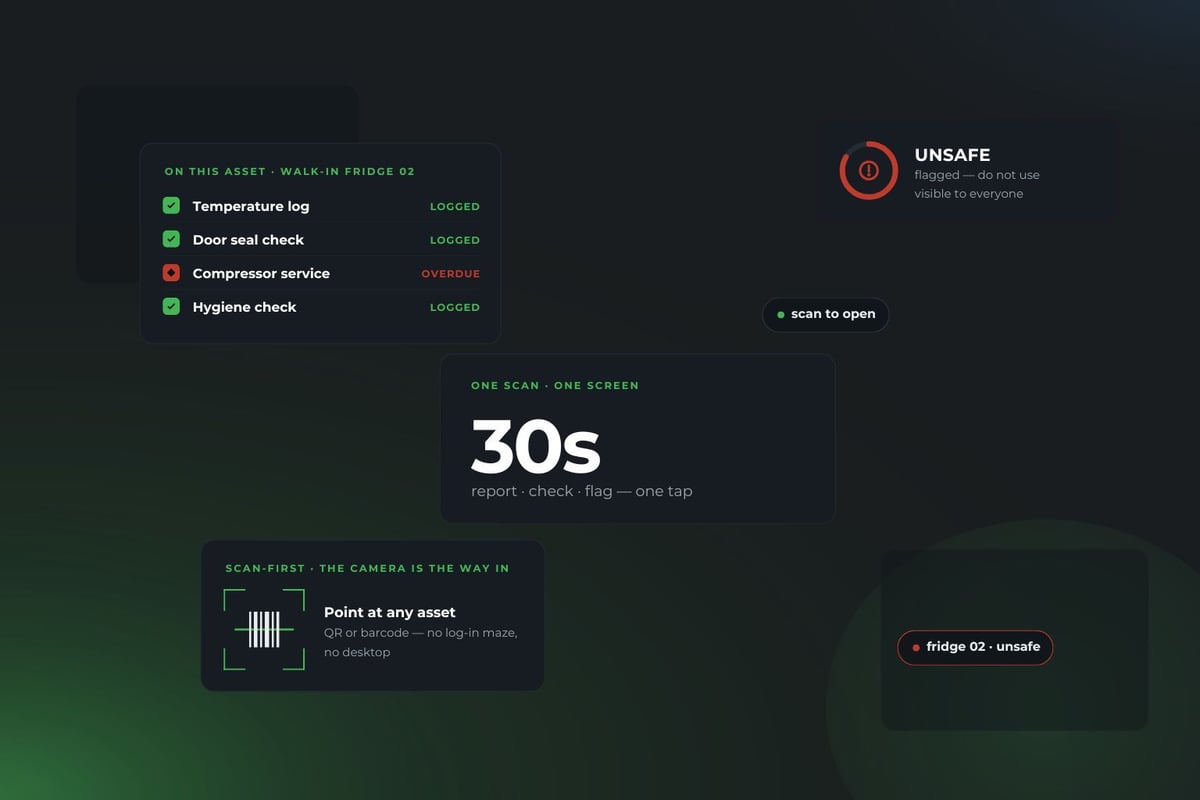
Walk into any plant room, kitchen or care home and ask a simple question: when was this piece of equipment last checked, and is anything outstanding on it? Often, nobody can answer. The information exists somewhere, in a service folder, a spreadsheet, the head of a maintenance lead who is off this week. It is just not where the person standing next to the equipment can reach it.
That is the real failure of most asset and maintenance software. Not that it lacks features. It has too many. It was built for an administrator at a desk, not a technician with a phone and thirty seconds. So the people who matter most quietly stop using it. They revert to paper, to WhatsApp, to memory. And the moment they do, the true status of your equipment becomes invisible to the organisation that depends on it.
Key takeaways
- Most asset systems fail because they are built for an administrator at a desk, not a technician with a phone and thirty seconds.
- When logging a fault is slow, frontline teams bypass the system and revert to paper, messages or memory.
- With ocapii, scanning an asset's QR or barcode opens one screen showing its status, what is due, what is open and its recent history.
- A plain safe, warning or unsafe status shows each asset's latest recorded condition, outstanding defects and required checks, so nobody is left guessing.
- Adoption follows when the simplest action is faster than not using the system at all.
A lot of frontline time still goes on low-value admin. A system that takes five minutes and three menus to log a fault does not get used twice. It gets bypassed. Plenty of teams are still running on paper for exactly this reason: the digital alternative was heavier than the problem it solved.
The fix is not just more training. It is a smaller front door. ocapii makes the camera the way in. A technician scans the QR or barcode on an asset and gets one screen: its latest recorded status, what is due, what is open, the checklists to complete and the recent history, with one-tap actions to report a fault, complete a check or add a photo. No hunting, no log-in maze, no desktop.
The most important thing on that screen is the one most systems hide. Every asset shows a plain safe, warning or unsafe status based on its latest recorded condition, alongside outstanding defects and required checks. If a fridge is flagged unsafe, the screen makes it hard to miss. The judgement that used to live in one person's head is now visible to everyone who picks up the equipment. That status reflects the latest recorded check, not proof the equipment is safe at the moment of use, so staff still follow isolation and inspection procedures and report any new defect they find.
This is the quiet shift. When the simplest possible action captures the most useful possible signal, adoption becomes much less of a training problem, although staff still need the right training and competence for the work itself. The frontline uses it because it is faster than not using it. And because they use it, the organisation can finally see what it never could: the latest recorded state of every asset, in the hands of the people closest to it.
You cannot master what your own team has stopped recording. Make the front door small enough, and the visibility looks after itself.
FAQs
Why do teams stop using asset management software?
Teams stop using asset software when it is slower than the problem it solves. If logging a fault takes several minutes and multiple menus, technicians bypass it and go back to paper, messages or memory.
What is scan-first asset management?
Scan-first asset management uses the phone camera as the way in: a technician scans the QR or barcode on an asset to reach its record. In ocapii, that opens one screen with the asset's status, what is due, what is open, the checklists to complete and the recent history.
How can frontline staff tell if equipment is safe to use?
Each asset can show a plain safe, warning or unsafe status based on its latest recorded condition, with outstanding defects and required checks, so staff are not left guessing. If an asset such as a fridge is flagged unsafe, it is shown clearly on the screen the moment it is scanned. The status is the latest record, not a guarantee at the moment of use, so staff should still follow isolation and inspection procedures and report any new defects.
Do you need lots of training to get technicians using an asset system?
Less, if the system is simple enough to be faster than not using it. One-tap actions to report a fault, complete a check or add a photo make adoption less of a training problem, though staff still need training and competence for the maintenance work itself.
One Assured Platform
Book an Operational Visibility Assessment. We map your current state and show where ocapii would unlock visibility, evidence and time.